New open-access journal article in the realm of museum analytics from the Museums in Pandemic project 🏛️.
📜 Andrea Ballatore, Valeri Katerinchuk, Alexandra Poulovassilis, and Peter T. Wood. 2024. Tracking Museums’ Online Responses to the COVID-19 Pandemic: A Study in Museum Analytics. ACM Journal of Computing and Cultural Heritage. 17, 1, Article 2 (2023), 29 pages. https://doi.org/10.1145/3627165
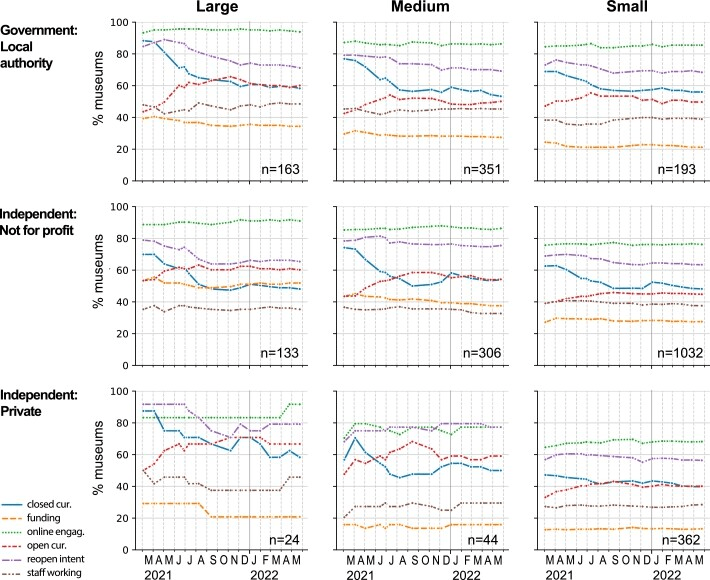
Figure 1: Indicators in three different categories of governance (y-axis) and size (x-axis). The y-axis in each chart shows the percentage of museums whose websites contain a reference to an indicator. The total number of museums in each group, n, is also displayed.
Abstract. The COVID-19 pandemic led to the temporary closure of all museums in the UK, closing buildings and suspending all on-site activities. Museum agencies aim at mitigating and managing these impacts on the sector, in a context of chronic data scarcity. “Museums in the Pandemic” is an interdisciplinary project that utilises content scraped from museums’ websites and social media posts to understand how the UK museum sector, currently comprising more than 3,300 museums, has responded and is currently responding to the pandemic. A major part of the project has been the design of computational techniques to provide the project’s museum studies experts with appropriate data and tools for undertaking this research, leveraging web analytics, natural language processing and machine learning. In this methodological contribution, firstly, we developed techniques to retrieve and identify museum official websites and social media accounts (Facebook and Twitter now X). This supported the automated capture of large-scale online data about the entire UK museum sector. Secondly, we harnessed convolutional neural networks to extract activity indicators from unstructured text to detect museum behaviours, including openings, closures, fundraising and staffing. This dynamic dataset is enabling the museum studies experts in the team to study patterns in the online presence of museums before, during, and after the pandemic, according to museum size, governance, accreditation and location.
 Cultural Geo-Analytics Lab